



Culture, Sky & Traditions
Why Does Diwali Fall on a Different Date Every Year?
The surprising connection between the Moon, the Festival of Lights and one of Britain's most spectacular celebrations.
Imagine if Christmas moved to a different date each year. On the Gregorian calendar, Diwali does just that. One widely used Hindu calendar put New Delhi’s main Diwali observance on 20 October in 2025 and 8 November in 2026. How can the same celebration move by nearly three weeks and still belong to the same season? [1] [2]
The answer is in the sky. The calendar behind many Diwali observances follows the Moon for its months and the Sun for its seasons. The two cycles come close to fitting together, with just enough of a gap to move the festival on a Gregorian calendar.
The clue is the Moon you can barely see
As the Moon orbits Earth, we see different amounts of its sunlit half. At new moon, that half mostly faces away from us and the Moon appears near the Sun in our sky. Later comes a waxing crescent, then a full moon, then a waning crescent before the cycle starts again. A new moon is usually invisible to the naked eye. [3]
For many Hindus, the principal night of Diwali falls during Amavasya, the final lunar day, or tithi, of the waning half of the month. It ends around the astronomical new moon. In the full-moon-ending Purnimanta system, this tithi is called Kartika Amavasya. In the new-moon-ending Amanta system, the corresponding tithi is at the end of Ashwin, just before Kartika begins. The month name depends on where the calendar draws the boundary. [4] [5]
A tithi is an interval defined by the changing angle between the Sun and Moon. It can straddle two civil dates. Many Lakshmi Puja calendars look for Amavasya during pradosh, the period after local sunset. That gives time zone, local sunset and a community’s observance rules a role in the Gregorian date. [2] [5]
Two clocks, one autumn festival
One phase cycle ≈29.53 days, new moon to new moon
- New moon
- First quarter
- Full moon
- Last quarter
- Next new moon
12 lunar cycles≈354.37 days
One seasonal solar year≈365.24 days
About 11 days apart. An extra lunar month, Adhika Masa, is added when the calendar calls for it. This keeps the named months near the same seasons while Diwali’s Gregorian date shifts.
Where the missing eleven days go
A phase cycle, or lunation, averages about 29.53 days. Twelve of them take about 354.37 days. The seasonal solar year takes about 365.24 days. If you counted twelve lunar cycles and stopped there every year, the named months would arrive about eleven days earlier in the seasons each time. Given enough years, an autumn festival would drift into summer. [6] [7]
The Hindu lunisolar calendar uses the Sun as well. In a common rule, if the Sun does not enter a new zodiac sign between two consecutive new moons, the interval is assigned an extra month, Adhika Masa or Adhik Maas. That sign change is called sankranti. The extra month depends on the relative timing of these events. It comes roughly every few years and can occur in different parts of the year. [5] [8]
There was an extra Jyeshtha month in 2026. It helps explain the swing from October 2025 to November 2026. The next two intervals in the table are shorter than a solar year, so the dates move earlier again. [9] [2]
Four dates that show the pattern
The dates below follow Drik Panchang’s Lakshmi Puja calendar for New Delhi, India. The Delhi High Court’s 2025 Diwali holiday also fell on 20 October. MyPanchang gives 21 October for its 2025 Delhi observance and agrees with the three later dates. Even for one city, published observance dates can differ. [1] [10] [2] [11] [12]
| Year | Gregorian date | Since the last date |
|---|---|---|
| 2025 | — | |
| 2026 | 384 days | |
| 2027 | 355 days | |
| 2028 | 354 days |
Look closely at 2026. The Delhi calculations place Amavasya from late morning on 8 November through midday on 9 November, so the first evening is already within the tithi. The U.S. Naval Observatory places the instant of new moon at 07:02 UTC on 9 November, or 12:32 p.m. in Delhi. The ritual date and the astronomical timestamp answer different questions. [4] [13]
What the lights mean
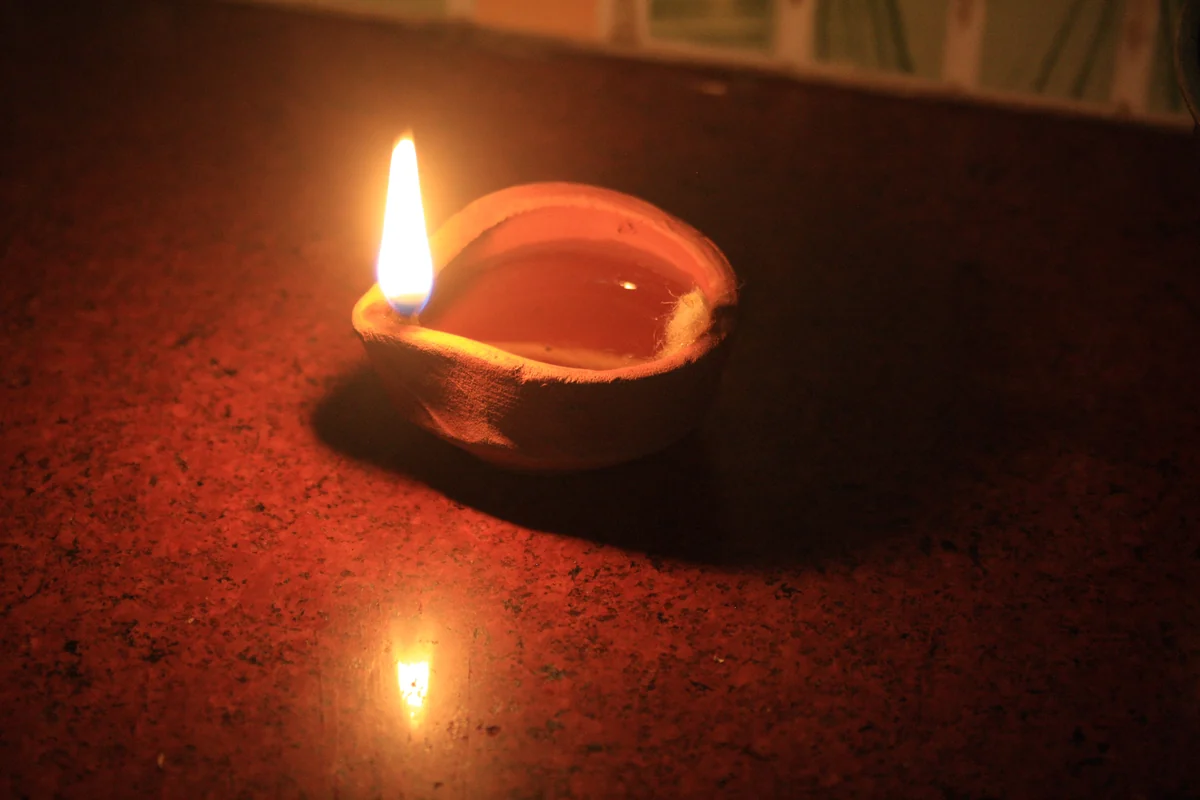
A diya is a small oil lamp, often made of clay. Rows of lamps can express the triumph of light over darkness, or hope and knowledge overcoming fear and ignorance. What people remember and how they celebrate vary with family, place and tradition. [14]
Hindu Diwali and Deepavali
Many families honour Lakshmi, associated with prosperity. Some recall Rama and Sita’s return to Ayodhya. Others commemorate Krishna’s defeat of Narakasura. Some traditions give particular importance to a different day in the festival period. The lamps can be familiar even when the stories, prayers and dates differ. [14] [4]
Jain Dīvālī
Jains commemorate Mahavira’s nirvana, or final liberation. Mahavira is the last of the 24 Tirthankaras, or spiritual teachers, in the Jain tradition. [15]
Sikh Bandi Chhor Divas
Many Sikhs mark Bandi Chhor Divas at the same time of year. It can coincide with Diwali. It commemorates the release of Guru Hargobind, the sixth Sikh Guru, from imprisonment. The occasion has its own history and significance in Sikh life. [16] [17]
How Diwali took to the streets in Leicester
Walk along the Golden Mile in Belgrave and you’re following Belgrave Road, where homes, shops and places of worship helped build a shared celebration. Leicester’s heritage account traces it to South Asian families, including people who came from India and East Africa, who kept traditions alive in their homes. The Belgrave Neighbourhood Centre, opened in a former Methodist church in 1977, gave people a place to come together for events and activities. [18]
In 1983, the first public Diwali lights went up along Belgrave Road, between Dorset Street and Loughborough Road. Community workers, residents and the council helped turn the idea into a public display. By the 1990s, the neighbourhood event was drawing visitors from further afield. The illuminated route connects places that are part of everyday life in Belgrave. That’s what makes Leicester’s celebration feel rooted in the city. [18] [19]
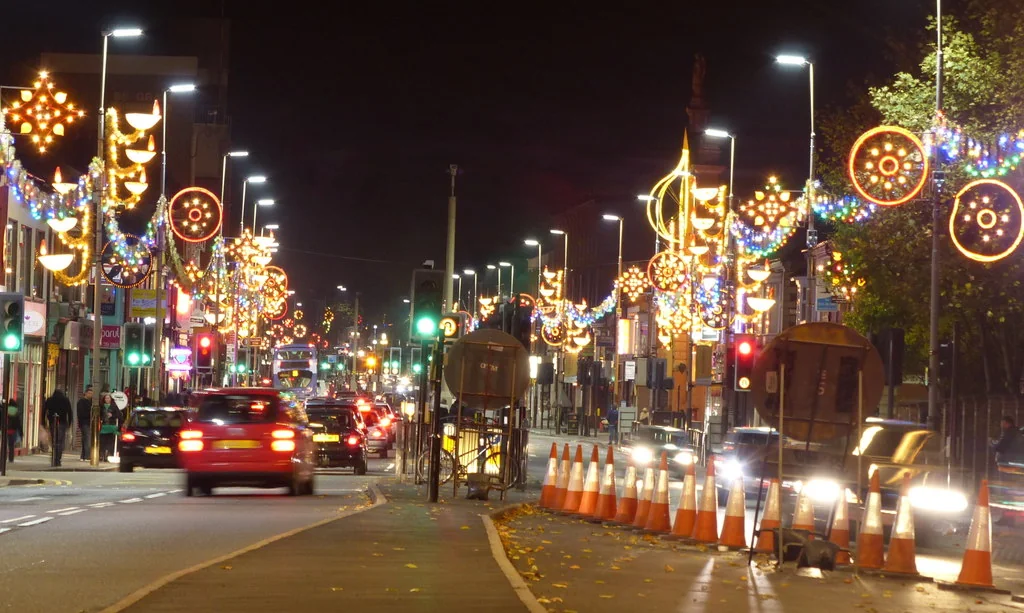
In 2026, the council reported on 27 October that the Golden Mile lights were already on. Its separate Diwali Day programme was on Sunday, 8 November, with the Diwali Village and community stage at Cossington Street Recreation Ground. The University of Leicester’s account confirms crowds gathered that Sunday. The street display had its own timetable, while the day’s public celebrations took place on Diwali itself. [20] [21]
Look for the Moon after Diwali
The new Moon itself is hard to see. Try looking low toward the west after sunset a few evenings later, when a waxing crescent may come into view. In The Sky Above, choose your location and date to see the Moon’s phase and illuminated fraction, then compare it with the date a few days later. [3]
Sources and further reading
- High Court of Delhi · October 2025 civil holiday calendar
- MyPanchang · Delhi Lakshmi Puja, 2026, and the month-name conventions
- NASA Science · Moon phases and new-moon visibility · NASA Goddard · first- and last-quarter illumination
- AstroReads · New Delhi Diwali calculations and Amavasya intervals
- Alessandra Petrocchi · Indian lunisolar month rules, Cardiff University repository (PDF)
- NASA Goddard · mean length of the synodic month
- U.S. Naval Observatory · the tropical year and Gregorian leap years
- BAPS Swaminarayan Sanstha · Adhik Mas (PDF)
- MyPanchang · 2026 Adhika Jyeshtha in the Amanta calendar
- MyPanchang · alternative 2025 Delhi Lakshmi Puja date
- MyPanchang · Delhi Lakshmi Puja, 2027
- MyPanchang · Delhi Lakshmi Puja, 2028
- U.S. Naval Observatory · November 2026 primary Moon phases
- Hindu American Foundation · regional Diwali traditions and symbolism
- Leicestershire County Council · Jain beliefs and festivals (PDF)
- Royal Commission on the Ancient and Historical Monuments of Wales · Bandi Chhor Divas
- Shiromani Gurdwara Parbandhak Committee · Guru Hargobind
- Story of Leicester · how Diwali grew on Belgrave Road
- University of Leicester · the 1983 lights and the 2023 anniversary
- Leicester City Council · October 2026 programme and Diwali Day
- University of Leicester · account of the 8 November 2026 celebration
Prepared with AI assistance and checked against the sources listed here. Send a correction.