
Names and numbers
How can a baby name rise in popularity when fewer parents choose it?
Sofia climbed from 31st to 17th in England and Wales while its birth count fell. Learn what baby-name ranks, counts and rates actually measure.
One name, two different answers
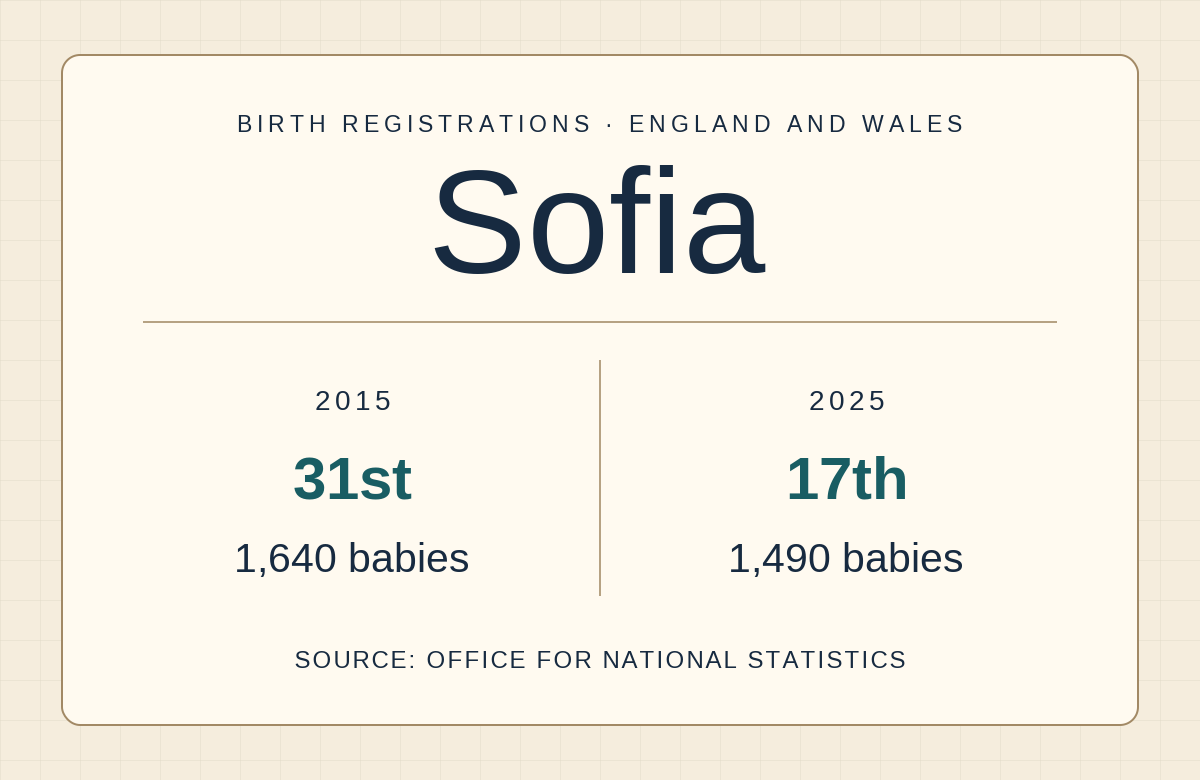
In 2025, Sofia ranked 17th among girls’ first names in England and Wales. A decade earlier it ranked 31st. You might expect that rise to mean more babies received the name. The Office for National Statistics (ONS) recorded 1,490 in 2025 and 1,640 in 2015. Sofia moved up 14 places while the published count fell by 150, or about 9.1%.
| Name | Year | Rank | Count |
|---|---|---|---|
| Sofia | 2015 | 31 | 1,640 |
| Sofia | 2025 | 17 | 1,490 |
| Sophia | 2015 | 12 | 2,744 |
| Sophia | 2025 | 13 | 1,547 |
Rank measures position in the pack
A count answers how many babies received a spelling in the table. A rank answers where that spelling placed among the other spellings that year. It is possible to overtake other names even while your own count drops. Imagine three names with counts of 40, 35 and 30. If the next year their counts are 20, 25 and 28, the third name becomes first even though its own count has fallen by two.
The Sofia and Sophia rows reveal a second effect. In 2015 the two counts were 1,104 apart. In 2025 they were only 57 apart. Both counts fell, but the gap narrowed. ONS counts the spellings separately because that is how they appear on birth records. If you choose to combine them for a question of your own, the two published counts sum to 4,384 in 2015 and 3,037 in 2025. Those sums answer a different question from the official rank of either spelling.
What to compare across places and years
Count is useful for asking how many. Rank is useful for asking what placed ahead of what. For comparing how common a name was in two differently sized birth cohorts, look for a rate, such as a count per 1,000 babies in the matching group. Divide the name’s count by the relevant total, then multiply by 1,000. Use the same age or birth cohort, spelling rule and sex category in the numerator and denominator. For that rate you need the size of the cohort.
Read the source notes when you change country. ONS covers England and Wales in this series. The US Social Security Administration’s name tables draw on Social Security card applications, and Statistics Canada explains its own sources and coverage in the Baby Names Observatory. Other lists may cover a state or province, or apply different rules to small counts. In the England and Wales national tables, ONS withholds names with fewer than three occurrences. Treat a missing value as unknown when a privacy rule could have withheld it.
Before treating a chart as a story about changing tastes, check what it actually reports. Sofia’s position improved, its recorded count fell, and its gap with Sophia shrank. All three statements can be true at once.
How popular is your own name — and has that changed?
Look up your first name and choose a country or region. Where birth counts are available, you can look up one year at a time.
Sources and notes
- ONS · 1996–2025 dataset, Table 1, girls’ counts and ranks
- ONS · exact spelling, coverage and disclosure rules
- US Social Security Administration · how its name tables are compiled
- Statistics Canada · Baby Names Observatory and data notes
Prepared with AI assistance and checked against the sources listed here. Send a correction.