
Space history
The spacecraft that reached Mars but could barely see its surface
Mariner 9 became the first spacecraft to orbit another planet in November 1971. Two mission photographs show how it waited out a planet-wide dust storm.
What the first photographs could show
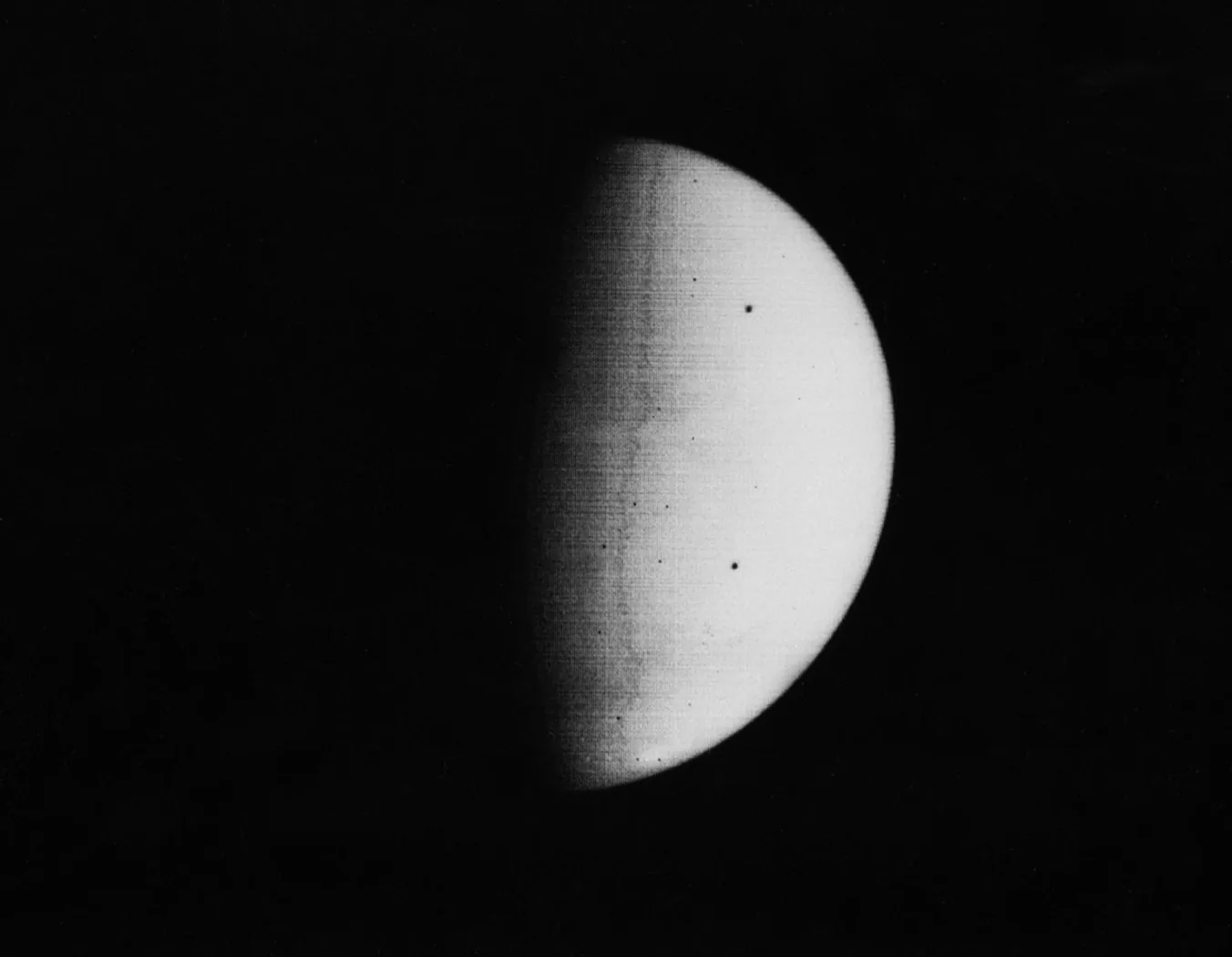
On 11 November 1971, Mariner 9 photographed Mars from about 445,000 miles away. The bright patch near the bottom of that picture is the south polar cap. Much of the rest is a hazy disc. By the time Mariner 9 reached orbit, a planet-wide dust storm still obscured most surface detail. The camera could see Mars. Seeing what lay on the ground was another matter.
The imaging team could make out the polar cap and a few dark spots through the dust. One was in a feature then called Nix Olympica, now known as Olympus Mons. Those early frames show how uneven the visibility was. A few recognisable points stood out while much of the terrain between them remained hidden.
Why the arrival has two dates
Mariner 9 became the first spacecraft to orbit another planet. JPL records ignition at 00:17:39 GMT on 14 November 1971. In California, it was still 13 November, at 4:17:39 pm Pacific Standard Time. About 15 minutes later, the completed burn left Mariner 9 in an elongated orbit around Mars, at approximately 00:33 GMT on the 14th.
As the dust cleared, canyons and volcanoes came into view
Earlier Mariner missions to Mars had flown past. A flyby offers a window of observation as the craft approaches and recedes. An orbiter can keep passing over the planet as it turns and return to regions under different conditions. It let the team keep observing while the atmosphere changed.
The mission team reported that the atmosphere began to clear during the third week, although surface contrast remained poor. NASA’s mission record notes that photographs taken before about mid-January 1972 still lacked much detail. The improvement took place in stages. The later frame below shows a canyon system emerging through the haze, with boundaries that were invisible in the early approach image. The images show different parts of Mars at different scales. Together they illustrate the change in what the mission could observe as the air cleared.
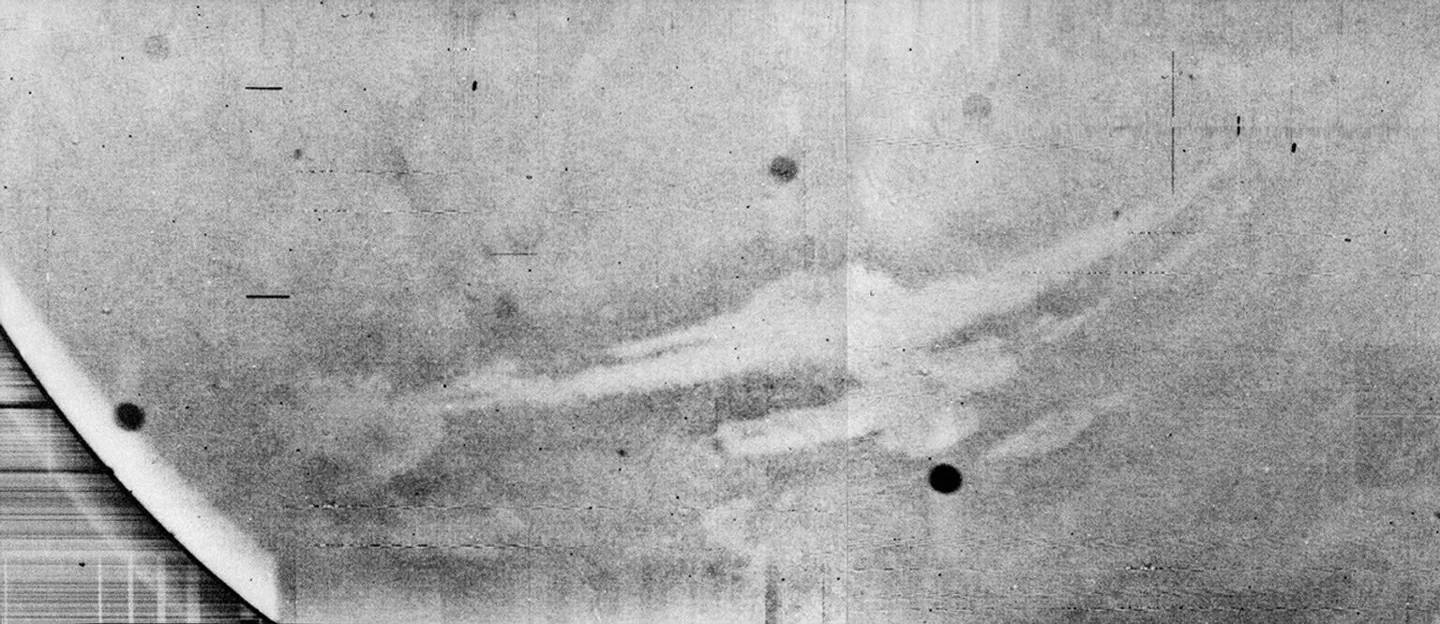
Mariner 9 went on to photograph the great canyon system now called Valles Marineris, giant volcanoes and Mars’s two small moons. The first pictures were already evidence of an active atmosphere. The later pictures supplied a much clearer view of the landscape beneath it.
Try a discovery of your own
Sources and notes
- NASA Science · mission results and actual burn time
- JPL technical report · ignition, burn duration and resulting orbit
- JPL · 1971 advance schedule in Pacific Standard Time
- NASA Science · earlier Mariner flybys and the 1971 Mars mission
- Masursky and colleagues · preliminary imaging results, archived by NASA
- NASA Photojournal · Mars on approach, PIA02996
- NASA Photojournal · canyon system, PIA02998
Prepared with AI assistance and checked against the sources listed here. Send a correction.